
Technical
Specifying Surfaces for High-Traffic Commercial Floors
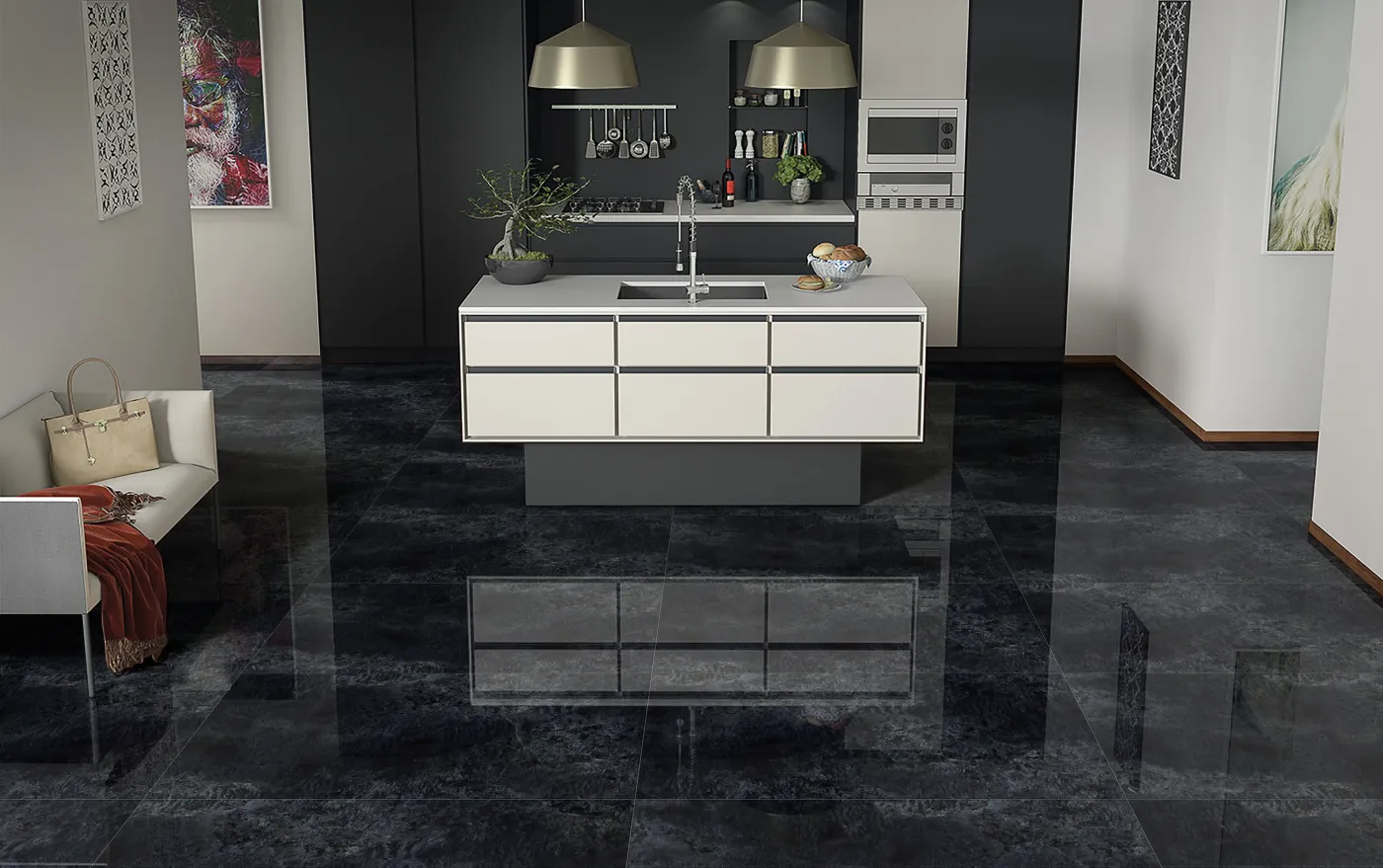
Commercial kitchen flooring installed with high-specification porcelain tiles. Photography: Montilla Studio.
Commercial flooring specifications live in numbers. PEI ratings, coefficient of friction, chemical resistance, modulus of rupture — these are not aesthetic considerations but performance requirements that determine whether a floor survives its environment or fails catastrophically.
Architects and specifiers need to understand what these numbers mean, why they matter, and how to read them from manufacturer data sheets with enough confidence to make decisions affecting buildings housing hundreds of people daily.
PEI Rating: The Wear Standard
PEI (Porcelain Enamel Institute) rating measures a tile's resistance to scratching and abrasion from foot traffic and rolling casters. The scale runs from 1 (least durable) to 5 (most durable):
- PEI 1: Light residential, bedrooms, low-traffic spaces
- PEI 2: Residential kitchens and bathrooms
- PEI 3: Commercial light traffic, offices
- PEI 4: Commercial high traffic, retail, restaurants
- PEI 5: Highest-duty applications, airports, hospitals, industrial
For commercial food service (restaurants, catering kitchens), PEI 4 minimum. For retail with constant foot traffic and rolling carts, PEI 4. For airports, distribution centers, hospitals — PEI 5.
Specifying below the rating your traffic demands means visible wear within 2–3 years: scratching, micro-chipping, a dull appearance. This is not a safety issue, it is an aesthetic failure that forces premature replacement.
Coefficient of Friction (CoF) and Slip Resistance
Wet floors are slip hazards. Commercial spaces — especially kitchens, bathrooms, and entry areas — must specify a minimum CoF to meet safety codes. Standards vary by region, but most commercial codes require a dynamic CoF of 0.60 or higher for slip resistance.
This is where aesthetic and safety collide. Smooth finishes (polished, glazed) have low CoF values (0.35–0.50). To achieve 0.60+ CoF, manufacturers introduce surface texture — lappato finish, structured grooves, anti-slip coatings.
A high-CoF surface reads textured, less refined. But it will not kill someone who walks on it while wet. The specification choice is not subtle — it is a direct tradeoff between elegance and safety. Safety wins.
For kitchens, specify lappato or anti-slip finish explicitly. For dining areas and office spaces where water exposure is limited, lower CoF is acceptable.
Chemical Resistance
Commercial floors encounter aggressive cleaning chemicals, spilled acids (vinegar, citric acid), alkaline cleaners, and solvents. Porcelain tile is inherently resistant to most of these, but the grout and sealants are vulnerable.
Glazed tiles can be damaged by sustained acid or alkaline exposure if the glaze develops micro-crazing. Colored-body porcelain is more resistant. Joints and grout lines are the weak points — they absorb chemicals and can stain or degrade.
For food service and chemical-exposure areas, specify epoxy or polyurethane grout (not cement-based), sealed with commercial-grade sealant. Porcelain tile itself will not fail, but poor joint specification will.
Modulus of Rupture and Load Bearing
MOR measures the strength of the tile itself — its ability to resist breaking under concentrated loads. For commercial flooring, this matters where heavy equipment rolls or is dropped: kitchens with carts, warehouses with hand trucks, service corridors with moving furniture.
Commercial-grade porcelain typically has MOR ≥ 50 MPa. If your floor experiences concentrated loads (a dropped tool, a rolled cart wheel), higher MOR provides safety margin.
For typical commercial restaurant or retail floors, MOR becomes less critical than PEI rating. But for loading docks, kitchens with daily equipment movement, or any area where heavy items roll, MOR should be specified explicitly.
Thickness and Installation
Commercial floors should be minimum 10mm thickness for wall or counter tiles, 12mm minimum for floor tiles. Thicker tiles (15mm, 20mm) are common in high-traffic areas because they provide better mechanical stability and have lower chipping risk under point loads.
Installation method matters: thin-set mortar on a properly prepared, level substrate is critical. Any deflection in the subfloor under load will cause tiles to rock and eventually crack. Commercial installations often use epoxy grout and mechanically-fastened setting bed systems for maximum stability.
Reading a Specification Sheet
Every manufacturer provides a technical data sheet. Essential data for commercial applications:
- PEI rating (required for commercial)
- Dynamic CoF value (wet surface)
- Modulus of rupture (MPA)
- Water absorption (should be ≤ 0.5% for commercial)
- Chemical resistance chart (acid, alkaline, solvent resistance)
If any of these are missing or unmarked, ask. Do not specify a material with incomplete technical data in a commercial application.
Conclusion
Commercial floor specification is not a design choice; it is an engineering requirement. The numbers determine whether the floor serves its building for 25 years or becomes a maintenance problem within 2. Architects who understand these metrics can specify with confidence and protect against premature failure and liability.