Materials
Stone or Porcelain? A Guide for Architects
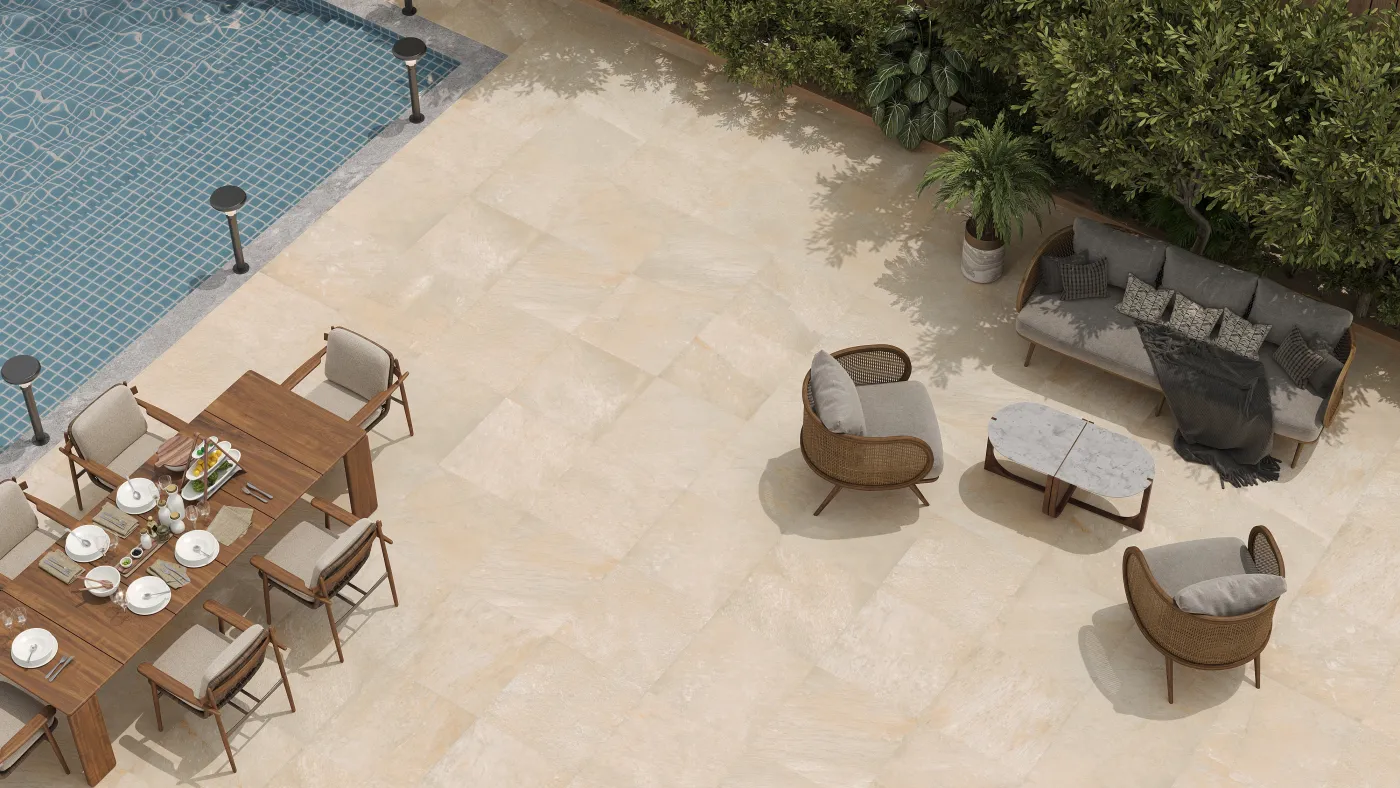
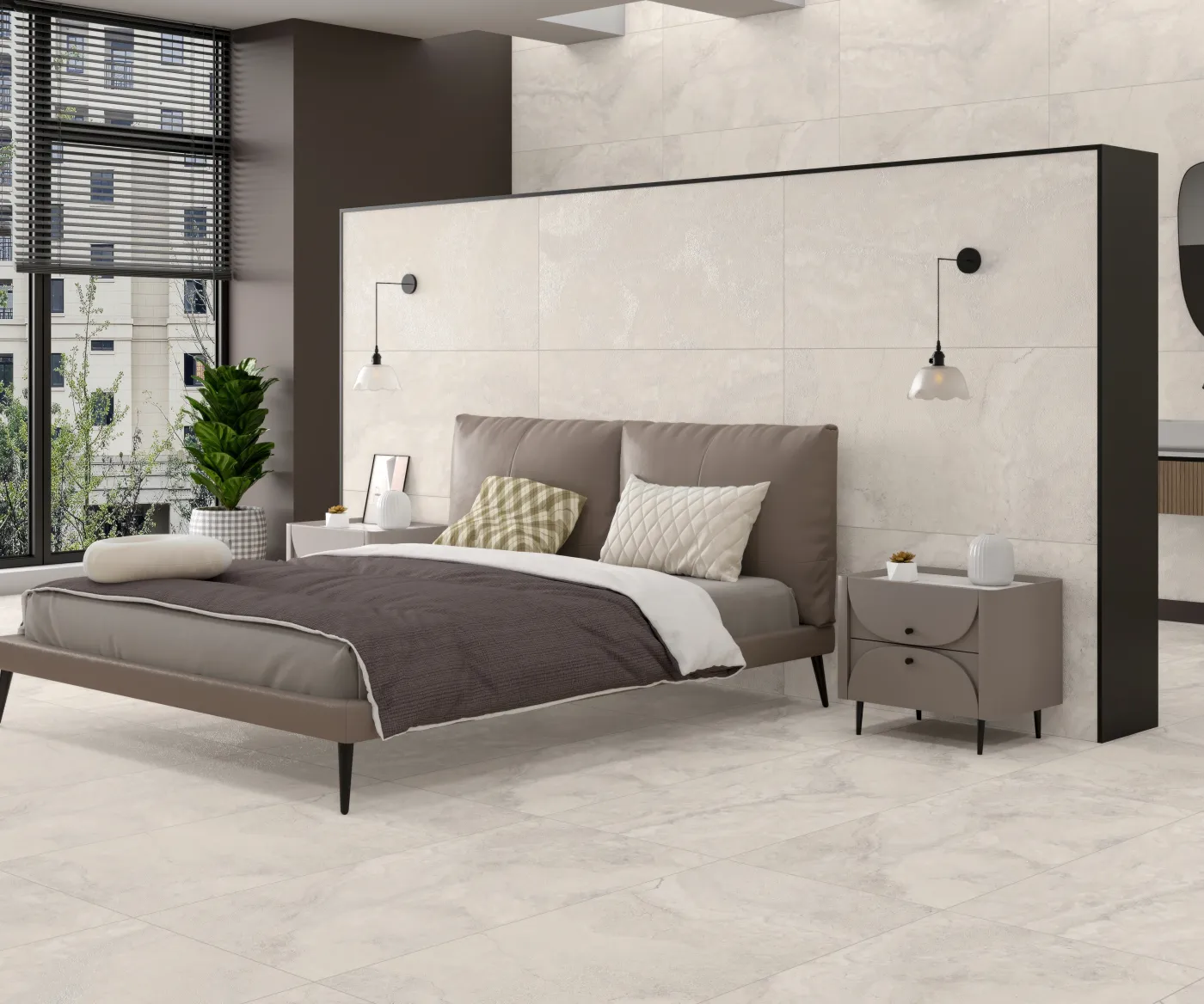
A frank comparison of performance, maintenance, cost and design range for specifiers choosing between natural stone and porcelain.

Design
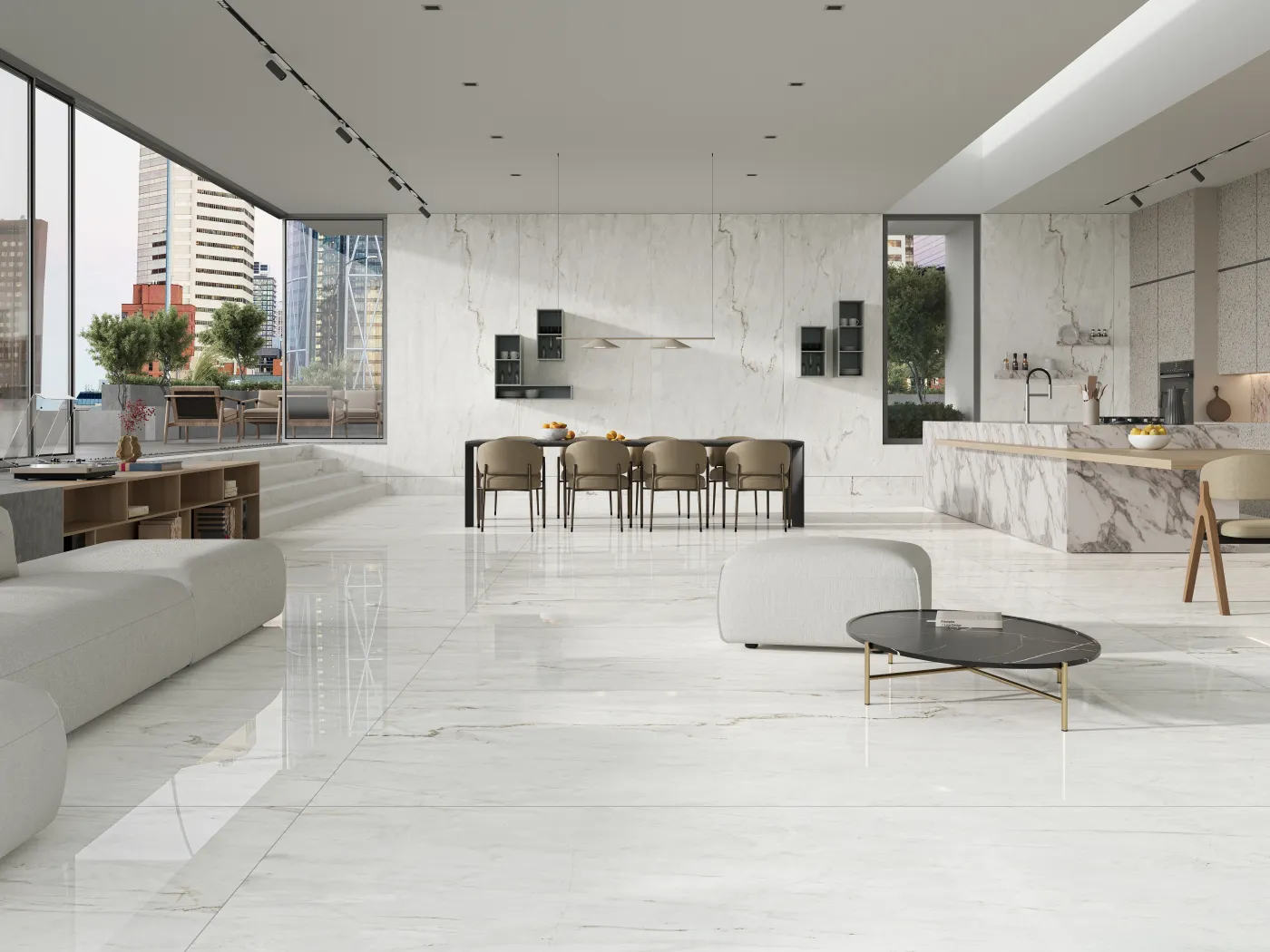
Large-format porcelain slab, 160 × 320 cm. Polished finish. Photography: Montilla Studio.
When you remove the grout lines, something shifts. Not just visually — though that shift is real, and dramatic — but in the way a room reads, the way light falls across a floor, and the way a surface holds its own against the architecture around it. Large-format porcelain slabs did not simply offer bigger tiles. They changed the grammar of how surfaces work.
For most of the last century, the grout joint was an accepted fact of ceramic installation. You could minimise it, colour-match it, even embrace it as pattern. But you could not remove it. The slab changed that — and with it, the entire logic of how surfaces relate to space.
Grout joints are maintenance points. They collect, stain, and fade. In commercial settings, they are a cost to manage across the full lifecycle of a floor. In residential bathrooms and kitchens, they are the detail that shows age first.
But grout joints are also a visual grid — an intrinsic pattern that competes with everything placed above it. Furniture, objects, light sources. The tighter the joint, the more the surface recedes. The larger the format, the quieter the floor becomes. At slab scale, the surface stops announcing itself at all. That is precisely the point.
Large-format porcelain doesn't just expand the surface — it changes how you read it. The vein in a marble-effect slab can run continuously across a wall, a worktop and a floor, following the same stone-logic through space. No reset. No interruption. The material argument is fundamentally about continuity.
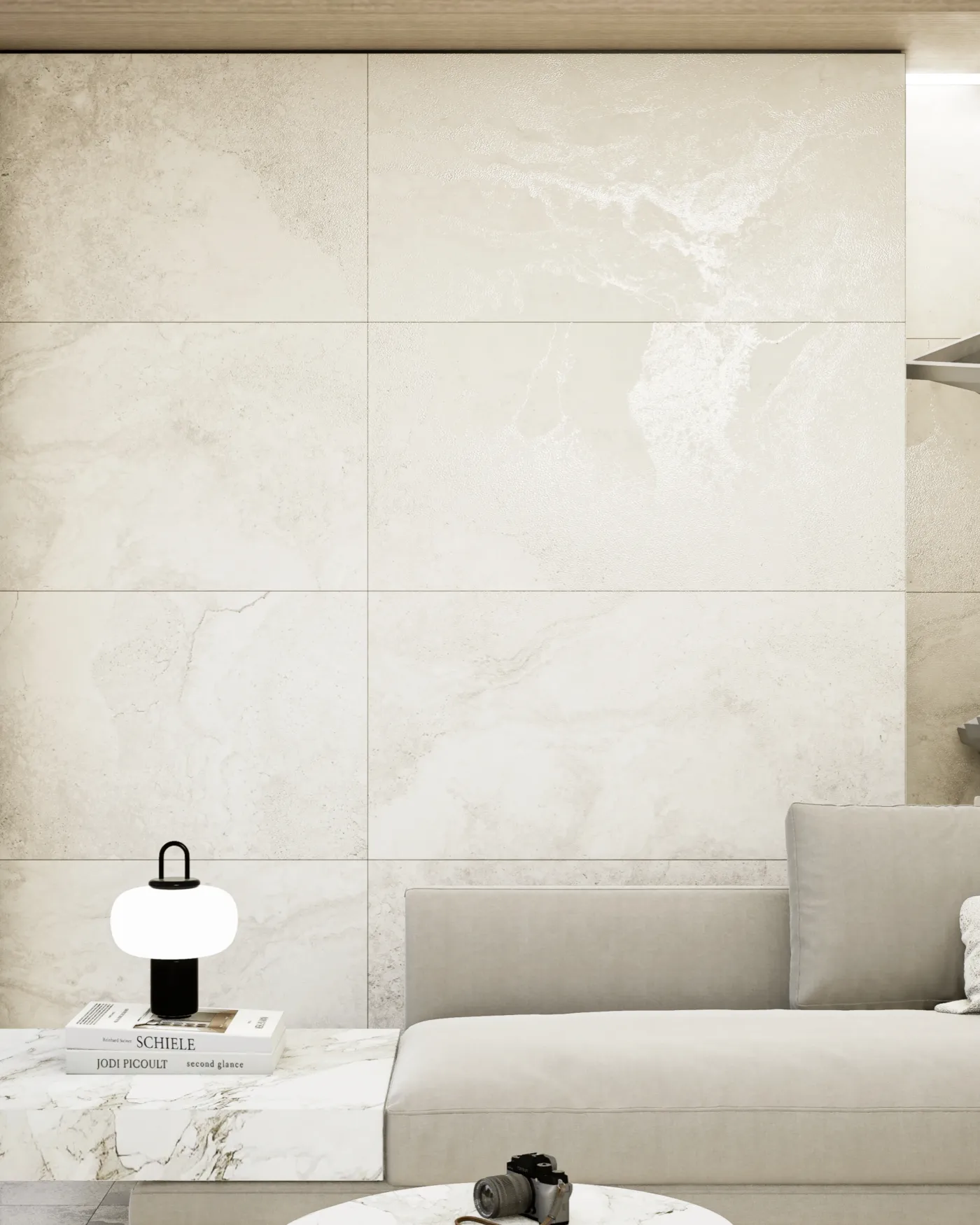
The best surfaces don't announce themselves. They extend the architecture into the ground, the wall, the worktop — until the room feels like one thing, not many things placed together.
The engineering prerequisites for large-format production are significant. A 160 × 320 cm slab requires a press capable of applying uniform pressure across a much larger area, a kiln system that can fire without warping, and edge rectification precise enough to achieve the sub-2mm joints that make the format worthwhile. None of this is straightforward.
The reward is a material that performs as architecture. Slabs can be used as furniture: island worktops, shelf faces, bath surrounds, door panels. The surface logic of the room becomes coherent rather than assembled from different materials at different scales.
Performance, not just aesthetics, makes the case. When specifying large-format porcelain, the checklist covers the fundamentals:
Porcelain achieves all of these simultaneously. Natural stone cannot. The trade-off is the loss of geological uniqueness — every slab from a given run will share the same digital pattern. But for most commercial and residential projects, the consistency is an advantage, not a concession.
The shift to large-format porcelain is not a trend with a peak and a decline. It is a permanent change in what is possible, and therefore in what is expected. Architects and designers who understand the material's capabilities — continuity, performance, scale — will find it one of the most versatile tools in a contemporary interior palette.
The grout joint is optional now. That changes everything.
Materials
A frank comparison of performance, maintenance, cost and design range for specifiers choosing between natural stone and porcelain.
Projects
Frost cycles, load ratings and anti-slip classifications — what matters when specifying surfaces for exposed terraces and pool surrounds.
Design
Large-format slabs have moved from premium exception to mainstream specification. What's driving the shift and how to install them correctly.
Next step
Browse the collection or talk to our team about your project.