
Industry
How the Middle East War Is Driving Up Morbi Tile Prices
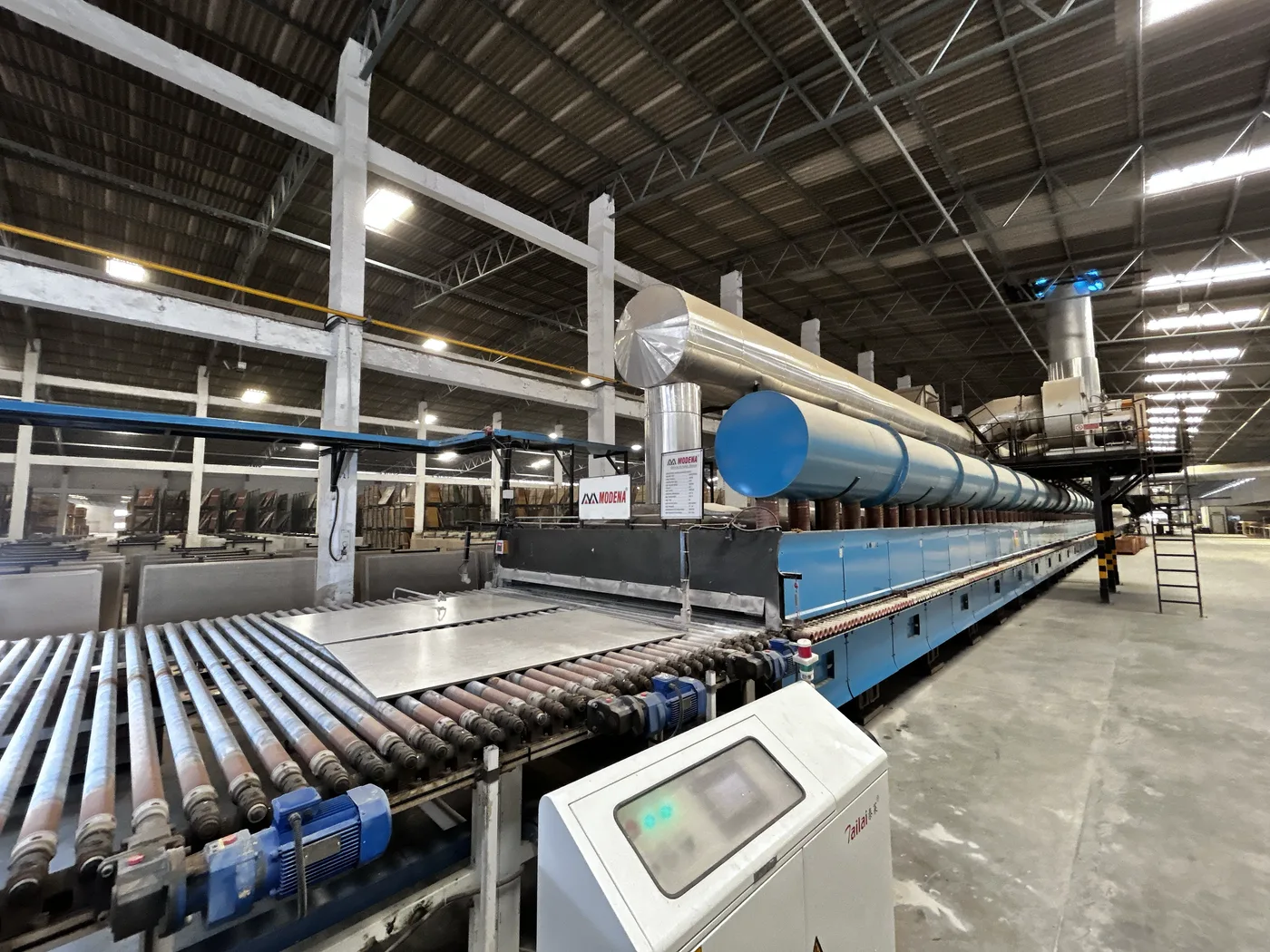
A gas-fired kiln line in morbi. Photography: Montilla Studio.
If a tile order from morbi has arrived later than promised this year, or a quote came back higher than the one before it, the reason likely has nothing to do with clay, glaze or design. It has to do with the Strait of Hormuz — a waterway more than 1,600 kilometers from the nearest kiln, and the single point of failure behind most of India's ceramic supply chain.
Why did Morbi tile prices go up in 2026?
Morbi's ceramic tile prices rose through 2026 because the region's kilns run almost entirely on natural gas, and that gas got scarce and expensive after fighting between Israel, the US and Iran raised the risk of a Hormuz shutdown. Indian gas companies were forced onto the emergency spot LNG market, paying record prices; Gujarat Gas cut industrial supply to the ceramic belt to protect it; and hundreds of factories that couldn't get gas either shut down or switched to far costlier propane. Less supply, at a higher cost, running fewer hours — that combination is what shows up on a buyer's invoice as a 10–20% price increase.
The Fuel Shock, Step by Step
Morbi's kilns fire continuously at temperatures above 1,200°C, and piped natural gas is what makes that economical at scale. When escalation between Israel, the US and Iran in early 2026 put the Strait of Hormuz — the transit route for a large share of the world's LNG and crude — at risk of closure, Indian importers had to compete for spot cargoes instead of relying on contracted supply. GAIL and Gujarat State Petroleum Corp reportedly paid upward of $23 per MMBtu for September-delivery LNG, among the most expensive cargoes India has bought since 2022.
Gujarat Gas, the utility supplying most of Morbi's cluster, responded by invoking force majeure and cutting industrial gas allocation to the ceramic belt by roughly half. Factories that could switch fuel turned to propane — but propane prices moved just as sharply, climbing from around ₹55 per kg to ₹100–120 per kg, erasing the cost advantage of switching at all.
What It Did to the Cluster
Morbi is home to roughly 1,800 ceramic and tile manufacturing units and accounts for around 90% of India's tile production — a $6 billion industry employing an estimated 400,000 workers, many of them migrants from Bihar and Uttar Pradesh. At the low point of the crisis, only about 83 of the region's ~670 gas-dependent units were still operating; more than 550 factories had gone cold. Reports from the ground described reverse migration as workers left for home states once shifts stopped.
Pricing moved in stages as the crisis unfolded. Dealers first reported an immediate ₹2–3 per square foot increase across most categories. Manufacturers then raised prices a further 15–20% in May as propane costs bit harder, followed by another 10–20% revision from 1 June — with some suppliers adding a 100% advance-payment requirement to protect against further volatility.
The Export Exposure
About a quarter of Morbi's output — roughly $1.5 billion worth — ships to the Middle East, Africa and Europe. Saudi Arabia and the UAE are among the cluster's largest buyers outside the US, with Saudi demand in particular accelerating on the back of Vision 2030 construction spending. A Hormuz-adjacent conflict is not an abstract risk for that trade lane: it sits directly across the shipping routes those exports depend on, and disruption there compounds a separate, ongoing problem — Red Sea rerouting around the Cape of Good Hope has already been adding 10–14 sailing days and 25–40% higher Asia-Europe freight rates since the Houthi attacks began. Buyers in the Gulf and Europe have effectively been facing higher landed costs and longer lead times from two independent sources of disruption at once.
Recovery, and the Competitive Risk If It Stalls
The cluster began recovering through April and May, as Gujarat Gas sourced spot cargoes from non-Middle East markets to stabilize supply. Gas consumption to the ceramic belt rose from roughly 0.36 mmscmd (serving ~83 units) at the end of March to about 2.70 mmscmd (~290 units) by late April, with volumes projected to reach 6–7 mmscmd and 675–700 active units by May.
The industry consensus is that the damage may stay contained to FY2026 if the conflict doesn't reignite — but a prolonged or repeated disruption would hit FY2027 harder, on exports, fuel costs and margins alike. That matters competitively: India is the world's second-largest tile producer at roughly 13–15% of global output, behind China, with Spain also a major exporter. Buyers who get burned on price or delivery reliability during a shortage don't always come back once it clears — every week Morbi runs short is a week China and Spain can use to win a customer relationship that took years to build.
What This Means If You're Buying
- Expect price volatility of 10–20% on quotes tied to gas-dependent production runs, not just a one-time adjustment
- Advance-payment terms have become more common industry-wide as manufacturers hedge against further fuel swings
- Lead times to the Middle East and Europe carry compounded risk right now — from both the Hormuz situation and the separate Red Sea rerouting
- Suppliers with their own gas contracts, propane reserves, or multi-fuel kiln capability are managing continuity better than smaller units buying spot
Montilla is not insulated from this. Our kilns run on the same regional gas network as the rest of the cluster, and the same LNG and propane cost pressure that hit the wider industry has hit our production costs too. Where we've focused instead is on how that gets managed: locking supply where we can, absorbing part of the volatility rather than passing through every spike immediately, and being upfront with clients about realistic pricing and lead times instead of quoting numbers that won't hold.
Our honest advice to anyone buying from Morbi right now: build price flexibility into your planning. Get quotes with a validity window, ask suppliers directly how they're sourcing fuel, and expect that a number confirmed today may need revisiting if the conflict drags on or gas allocation tightens again. That volatility is a feature of the current market, not a sign of any one supplier overcharging — and it's likely to stay until the underlying gas supply stabilizes for good.