
Design
The Slab Revolution: Seamless Surfaces in Contemporary Interiors
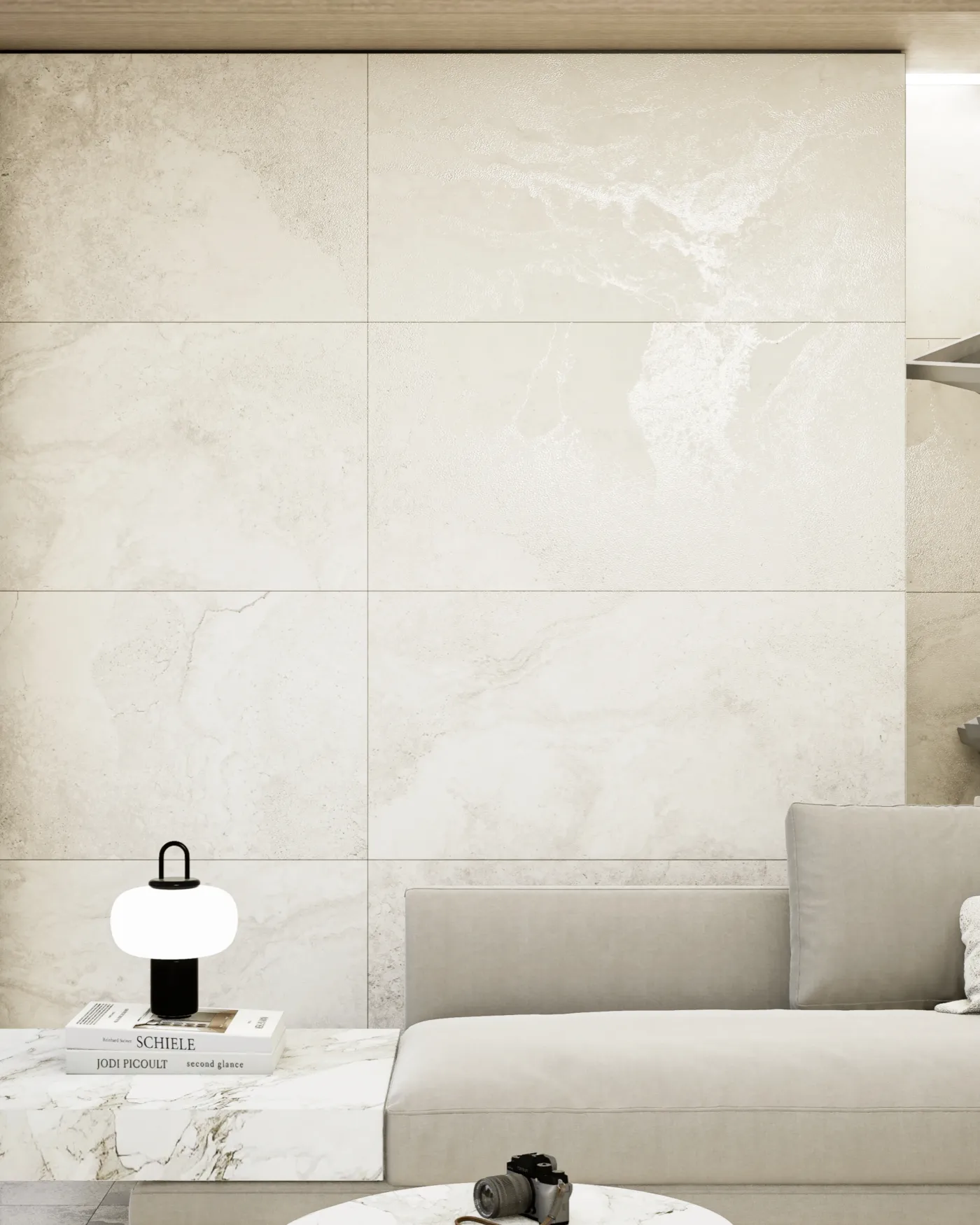
Large-format slab spanning wall, countertop, and floor with seamless visual continuity. Photography: Montilla Studio.
Ten years ago, large-format porcelain slabs were an exception — a premium choice for signature projects and high-end interiors. Today they are increasingly mainstream, specified across residential, commercial, and hospitality projects as the default surface for continuity and scale.
This shift is not merely about size. It represents a fundamental change in how contemporary design approaches surfaces — not as applied finishes but as material logic that extends through space without interruption.
What Defines Large-Format
Large-format slabs begin at 120×240 cm and extend to 160×320 cm and larger — dimensions that fundamentally change how a surface reads. Standard tile (30×60 cm) creates a visual rhythm through grout lines. Large format removes that rhythm entirely, allowing the material's own texture and character to dominate perception.
The engineering challenge is substantial. Pressing clay to 160 cm requires equipment capable of applying uniform pressure across a massive area. Kilns must fire without warping. Edge rectification must hold tolerance to ±0.2mm so joints remain tight and invisible. This is why large-format remains more expensive than standard tile.
But the cost differential has compressed significantly as manufacturers have invested in the technology. Ten years ago, large-format cost twice as much. Today it is often only 20–30% premium, making it financially viable for mainstream projects.
The Design Logic of Seamlessness
When you can run a single material continuously across floor, wall, and worktop without visible interruption, the spatial logic shifts. The architecture becomes subordinate to the surface. A kitchen with seamless lapato porcelain on the floor and running up the backsplash and across the countertop reads as a singular, unified space rather than an assembly of planes meeting at corners.
This is not just aesthetics. It is a material expression of contemporary minimalism — the absence of interruption as a design statement. For architects working in reduced-detail, refined aesthetics, large-format slabs have become a primary tool.
Veining and Pattern Continuity
When digital printing technologies advanced, they enabled something previously impossible: a single vein or grain pattern running continuously across multiple slabs. Marble-effect porcelain can be printed so that the vein running off one slab picks up exactly where the next slab begins, creating the illusion of a single stone book-matched across 6+ meters of surface.
This is technically complex (requires careful design, precise installation, and accurate cutting), but the visual reward is significant. A floor or wall that reads as one continuous slice of material, not a series of tiles, is a powerful design move.
Installation and Logistics
Large slabs demand respect during handling, shipping, and installation. Breakage during transport was a serious problem in early adoption, though manufacturing advances and professional shipping practices have improved significantly. On-site, installation typically requires experienced tile setters who understand the weight (a 160×320 cm slab weighs 80+ kg) and the precise leveling required for invisible joints.
For wall applications, mechanical fastening systems are often employed instead of adhesive alone, ensuring slabs don't shift or crack due to their own weight. Worktops often require substrate reinforcement to prevent deflection under load.
These logistical considerations increase cost beyond material and labor for standard tile. But for projects where the design intent justifies it, the investment produces results impossible to achieve any other way.
Color and Finish Possibilities
Large-format slabs are available in the full range of porcelain finishes: polished, lappato (matt with light texture), structured, anti-slip. Colored bodies are common, allowing edge conditions to maintain visual continuity without revealing raw white porcelain at cuts and breakouts.
Neutral tones dominate specification (whites, grays, blacks, beiges) because they read as refined and timeless. Bold colors are possible but riskier — a large expanse of strong color will dominate a space's perception far more than the same color in small tiles would.
When Large-Format Makes Sense
Large-format slabs are ideal for:
- Kitchens where countertop, floor, and backsplash should read as unified
- Bathrooms with minimal visual interruption
- Commercial spaces where scale and minimalism reinforce brand perception
- Lobbies and entry halls where visual elegance is paramount
- Retail environments where seamless surfaces create visual flow
They are less essential for spaces where material contrast is intentional, or where budget constraints prevent the premium. For these projects, large-format is not required to create beautiful results.
The Lasting Shift
Large-format porcelain slabs are no longer a trend. They have become a permanent shift in what is possible and therefore in what is expected. For architects and designers who understand their possibilities and constraints, they are one of the most versatile tools in a contemporary material palette.